Oh my God how my heart hurts.
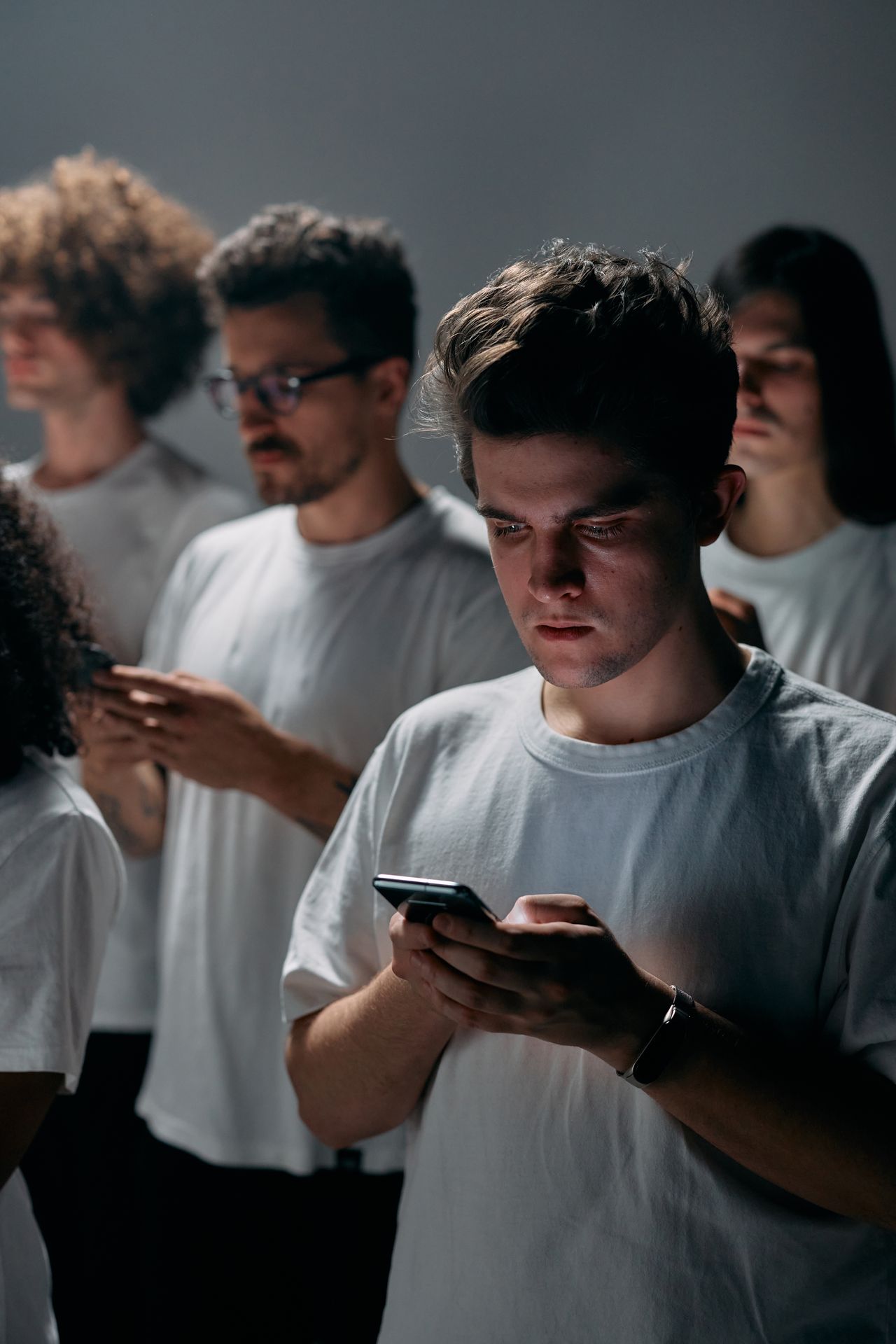
Fifty-seven phones went off that belonged to fifty-seven young men in a Cornell fraternity Snapchat group at 1:42 a.m. one October morning in 2024. A grotesque message appeared in that group chat suggesting that a woman upstairs was available for sex. There is video evidence of portions of the group conversation. The young woman reported that she had been drugged and sexually assaulted by multiple men. The young men who have responded through attorneys have denied the allegations. The original criminal investigation was closed without charges and has now been reopened; Cornell’s handling of the case is also under scrutiny.
But I cannot stop thinking about the phones.
Not because fifty-seven people have been accused of committing a crime. They haven’t.
Because fifty-seven young men represent something way more concerning. Something way more important.
They represent what can happen to our humanness when we are together.
Some may have been asleep. Some may not have seen the messages. Some may have been intoxicated. Some may have had no idea what was actually happening upstairs. Some may have read the words and felt something in their stomach turn.
We don’t know. And that uncertainty matters.
But so does the question it leaves behind:
What makes a human being get up and do something? What does it take to act?
What makes someone say, What the fu@k! is going on upstairs?
And what makes someone remain seated? And silent…
I have spent much of my professional life thinking about health. Usually that means bodies: digestion, hormones, nervous systems, inflammation, sleep, metabolism, aging, disease.
Increasingly, I don’t think the body is large enough to contain the subject of health.
Because health is also the capacity with which we encounter reality. It is our ability to remain in relationship with ourselves, with other human beings, and with the environments in which we live.
And fifty-seven phones have me wondering about the health of us.
Medicine Already Knows We Don’t Exist in Isolation
Interestingly, public health already has language for this.
The CDC approaches violence through what it calls a social-ecological model. Instead of asking only what is wrong with an individual who commits violence, the model examines four interacting levels: the individual, relationships, community and society.
It is deliberately nonlinear.
The CDC describes the levels as overlapping because what happens in one influences what happens in another. Prevention therefore cannot happen only by changing individuals. It also means changing relationships, communities and social conditions.
For sexual violence specifically, the CDC identifies risk factors ranging from substance use and lack of concern for others to aggressive peer groups, weak institutional sanctions, sexual entitlement and societal norms that maintain inequality. It also identifies protective factors—including emotional connectedness, empathy and concern for the consequences of one’s actions.
That sounds like health to me.
And it raises a question medicine rarely asks:
Where does the self end?
I use an eight-layer model of self in my own clinical thinking—not because a human being divides neatly into eight parts, but because it keeps me from making one of the mistakes we make constantly in medicine and culture: explaining a complex human through a single cause.
Physiological. Ecological. Sociological. Psychological. Ancestral. Cultural. Evolutionary. Existential.
They are not stairs. They are not boxes. They are not a tidy progression toward enlightenment. They are constantly moving through one another.
The world enters us.
We enter the world.
And then the world enters us again.
Fifty-seven phones sit somewhere inside that recursion.
Before the Phones Ever Light Up
We are animals before we are doctors.
We possess sexual drives, aggression, fear, desire, reward systems, impulses, hunger for status and extraordinary capacities for attachment and care.
The physiological matters.
Add alcohol. Drugs. Sleep deprivation. Sexual arousal. A young nervous system. A room full of other people doing the same thing.
But risk factor does not mean cause, and biology does not erase responsibility.
Quite the opposite.
One of the extraordinary achievements of being human is our ability to have an impulse without being required to become it.
We cannot build moral agency at 1:42 in the morning.
It has to exist before we enter the room.
Before we drink.
Before we alter our consciousness.
Before desire becomes intense.
Before anger overwhelms us.
Before everyone around us is telling us something is acceptable when somewhere inside ourselves we know that it isn’t.
There are laws outside of us for good reason. There must be.
But no external rule can replace an internal relationship with one’s own values.
Perhaps one dimension of health is precisely this:
Can I remain responsible for myself—and responsible to others—even when my own biology is pulling me toward something my deeper self knows I should not do?
And Then We Enter a Room
Human behavior always happens somewhere.
A fraternity house does not cause sexual violence.
Neither does a locker room, nightclub, church, military barracks, dormitory, boardroom or political rally.
But environments shape possibility.
They establish what is normal, what is rewarded, what gets laughed at, what gets hidden, who has status, who gets protected, who is believed, who is disposable.
An environment ripens certain opportunities.
That doesn’t mean everyone within it is guilty of everything that occurs there.
But eventually, participation in a human environment asks something of us.
This is where fifty-seven phones become so difficult for me.
Because there are two really important questions:
What did they do?
and:
What did they allow while choosing to do nothing?
Those are two very different questions. And we should never confuse them.
Both questions need answers.
And we should never pretend they have nothing to do with one another.
Fifty-Seven Phones
This is where conscience meets belonging.
Research on sexual violence among college men gives us uncomfortable clues. A systematic review of longitudinal evidence found that prior perpetration was the strongest predictor of later perpetration—an important challenge to any simplistic claim that fraternities simply turn otherwise healthy men into perpetrators.
For some, this started way before the fraternity.
But peer approval of sexual violence and fraternity membership also predicted perpetration. In that analysis, peer attitudes appeared more consequential than an individual’s own rape-supporting beliefs.
Think about that.
A person can know one thing internally and behave differently because of the human beings surrounding him.
Conscience may be individual, but courage is profoundly social.
And suddenly fifty-seven phones become something other than a grotesque situation.
They become a question about human development.
At nineteen, we allow someone to drive a two-ton vehicle down a highway. At eighteen, our country can train a young adult to carry a weapon in war and utilize that power as necessary. We send young people away from home and expect them to negotiate sex, drugs, money, education, relationships, identity and enormous amounts of freedom.
So when do we teach them how to withstand the group?
When do we cultivate the capacity to say:
No.
Not because it violates university policy.
Not because someone might record it.
Not because punishment might follow.
Because something within them says:
This is wrong.
And then—perhaps harder—
I am willing to become unpopular in order to act upon what I know.
That is not merely sexual-assault prevention.
That is human conscious formation.
The World Comes Back Inside
And then the social becomes psychological once again.
What happens inside us when we betray something we know?
What happens when we remain silent?
What stories do we tell ourselves afterward?
What happens when shame enters? When rationalization does? When everyone else says it wasn’t a big deal?
And what happens when we do the opposite?
What happens when a nineteen-year-old says stop and discovers that he survived being the unpopular person in the room?
Maybe courage is strengthened through use.
Maybe integrity is too.
The culture becomes us.
And then we become culture.
This is why I resist calling these young men monsters.
That isn’t leniency.
It is actually a much harder proposition.
Monsters relieve us of responsibility.
If terrible things are committed by creatures fundamentally unlike us, the rest of us can sleep peacefully.
But if human beings can participate in terrible things—and watch them unfold, rationalize them, laugh at them, remain silent around them—then we have to understand the conditions that cultivate those responses.
What happens when belonging outranks conscience and when young men are effectively initiating one another into adulthood without mature guidance around them?
Asking that question does not diminish anyone’s responsibility for what they did. It asks us to take responsibility for understanding how human beings arrive there at all. Because if we refuse to understand the conditions that cultivate harmful behavior, condemnation may satisfy our outrage while doing very little to prevent the next group of young men from repeating it.
Masculinity Cannot Become the Pathology
This is where weak conversations tend to collapse.
Something horrific happens involving men, dominance and sexual violence, and we begin talking about toxic masculinity.
There are legitimate reasons for examining forms of masculinity organized around entitlement, aggression and dominance. The CDC itself identifies hypermasculinity, hostility toward women and norms supporting male superiority and sexual entitlement among relevant risk factors.
But masculinity itself cannot become the disease.
Nor is femininity the cure.
Human beings contain capacities that cultures have historically coded masculine and feminine: assertion and receptivity, competition and cooperation, protection and nurturing, differentiation and relationship, strength and tenderness.
The precise mixture of biology, culture and history within those categories is a conversation much larger than this one.
But I wonder what happens when any human system hypertrophies one set of capacities while allowing others to atrophy.
Strength without tenderness.
Power without responsibility.
Belonging without conscience.
Sexuality without relationship.
Individualism without obligation.
Receptivity without boundaries.
Protection without humility.
What happens when we teach one half of these capacities and neglect the other?
And perhaps the next question is where we learned them in the first place.
What models of adulthood did we inherit?
What did our fathers teach our sons? What did our mothers teach our daughters? What did they teach across those lines?
What did coaches, teachers, clergy, elders, grandparents and communities once provide—and what did they get terribly wrong?
We cannot romanticize our ancestors. They handed us wisdom and brutality.
Some traditions deserve preservation.
Others desperately need to end.
Maturity requires something more difficult than either nostalgia or rejection.
It requires discernment.
What deserves to be carried forward?
And Then There Is Power
This may be the cultural question underneath all the others.
We live in a society obsessed with power while pretending we are mostly arguing about values.
Money can create power. Beauty can create power. Sex, status, physical strength, victimhood, righteousness, religion, politics, fame and attention can all become forms of power.
None is inherently the same as domination.
What matters is what happens between people when that power is exercised.
Because power is relational. It changes what another human being is able—or believes they are able—to do.
I can use my power while leaving yours intact.
I can use it to strengthen your agency.
Or I can increase my power by diminishing yours.
And maybe this is the distinction we are failing to make.
Power and domination are not the same thing.
A parent has power. A teacher has power. A physician has power. A coach has power. A political leader has power.
So does the strongest person in a room.
So does the most beautiful.
The wealthiest.
The funniest.
The person everyone desperately wants to belong to.
Power can protect. It can teach. It can create. It can interrupt harm. It can make room for someone else to become more fully themselves.
And power can dominate.
Humiliate.
Manipulate.
Coerce.
Exploit vulnerability.
It can make another human being smaller so that I can experience myself as larger.
That form of power interests me here.
What happens when my experience of power depends upon your loss of agency?
Because suddenly we are back in that fraternity house.
Sexual assault is an extreme violation of agency. But the group chat presents another, quieter form of the question.
What power did the group have over the individual young man reading his phone?
What would he risk by challenging them?
Status?
Brotherhood?
Belonging?
And what power did he still possess to choose differently?
What happens when fifty-seven individuals each quietly surrender a little of their own agency because everyone believes the group possesses more power than they do?
That question reaches far beyond a fraternity house.
This is where algorithms become interesting to me.
Politics.
Pornography.
Religion.
Celebrity.
Social movements.
The manosphere.
Even moral righteousness.
Each can tell us what deserves our attention, what should make us afraid, what kind of person belongs, what kind should be rejected, what we should desire, what we should hate and, increasingly, what we should think.
None invented the human appetite for dominance or belonging.
No president invented it.
No fraternity invented it.
No political party invented it.
No generation invented it.
But leaders, institutions, technologies and communities can become extraordinarily good at discovering those appetites and using them.
They can reward them, market them, normalize them, challenge them or constrain them.
And our algorithms have become astonishingly sophisticated at learning exactly what activates us and feeding it back to us.
Somewhere in that process, our minds and hearts can end up sitting in the back of the bus watching.
Which returns the question of power to the same place this entire essay keeps returning:
The self.
How much of myself am I willing to surrender in order to belong?
And its mirror:
How much of someone else must be surrendered for me to feel powerful?
Perhaps the health of power is revealed not by whether we possess it, but by what happens to the agency of the people around us when we use it.
Here Is the Part That Makes Me Uncomfortable
We did not evolve to be harmless.
I think we sometimes avoid saying this because we are afraid description will sound like justification.
It isn’t.
Humans carry capacities for aggression, coalition-building, sexual competition, jealousy, territoriality, status seeking and dominance.
We also carry capacities for pair bonding, cooperation, empathy, caregiving, reconciliation, altruism and extraordinary self-sacrifice.
All of it is human.
Evolution does not provide our moral code.
It gives us pressures and possibilities.
Culture helps determine what we do with them.
And humans have been negotiating those boundaries for a very long time.
We can watch this boundary-making happen across generations. Not long ago, women’s participation in elite athletics challenged prevailing ideas about femininity. Today female athletes can be cultural icons worth millions—and we have simply moved to a new set of negotiations: too feminine, too masculine, too muscular, too sexual, too aggressive, not marketable enough.
We move a boundary.
Then we discover another one.
That makes me wonder about some of the extremes we see throughout contemporary culture.
Are human beings testing boundaries because boundaries have always been how we discover ourselves?
Are some increasingly extreme forms of sexuality, identity, dominance, performance and spectacle attempts to discover where the edges now are?
Does increased control provoke rebellion against control?
Does liberation create new forms of exploitation?
Does the breaking of one taboo simply expose the next?
I don’t know.
And I don’t think we should pretend to know.
But those questions belong in the middle of the conversation—the uncomfortable place between moral panic and moral permissiveness where human beings actually live.
Because the alternative is an endless pendulum.
One side gains power.
The other feels threatened.
The threatened side pushes harder.
The first side becomes more absolute.
We alienate.
We shame.
We banish.
We hide.
We find increasingly grotesque ways to provoke one another.
And somehow everyone becomes convinced that the problem is entirely located in the people across the room.
Until We Return to the Self
After biology has had its say.
After the room.
After the fraternity.
After our parents and ancestors.
After pornography and religion and feminism and patriarchy and algorithms and politics.
After evolution.
After culture.
After every force that has helped make us who we are—
there remains a question.
Who am I going to be?
Not Who have I been told to be?
Not What does my group believe?
Not What can I get away with?
Not even What am I feeling right now?
Who am I going to be in relationship with all of it?
Can I live according to my own moral commitments inside uncertainty?
Can I tolerate the discomfort of being different from the people I love?
Can I recognize another person’s humanity when my group has temporarily stopped seeing it?
Can I use my strength not merely to preserve my own autonomy, but to protect the autonomy of someone who cannot fully exercise theirs in that moment?
Can I remain sufficiently established within myself to encounter the pressures of the world without surrendering my humanity to them?
Maybe that is health too.
Fifty-Seven Opportunities
There is one reason I don’t want to end this essay in despair.
We actually know something about prevention.
The CDC recommends changing social norms, teaching relationship skills, creating protective environments, engaging men and boys as allies and using bystander approaches. Programs such as Green Dot, Coaching Boys Into Men and Bringing in the Bystander are among the approaches it identifies.
Interventions appear to work better when they understand the culture they are entering. Peer leadership, interactive training and material tailored specifically to the current culture emerge as promising practices.
The fraternity isn’t the only problem.
The group can become part of the protection.
That changes the image for me.
Fifty-seven phones are not merely fifty-seven opportunities for silence.
They are fifty-seven opportunities for interruption.
One person says something.
Another realizes he wasn’t the only one uncomfortable.
A third gets up.
Someone checks upstairs.
Someone calls a friend.
Someone calls for help.
Someone makes it socially impossible to continue.
Perhaps courage moves through groups just as fear does. Perhaps conscience can become contagious too.
And maybe this is why health cannot end at the boundary of one’s body.
The physiological becomes ecological. The ecological becomes social. The social becomes psychological. The psychological carries the ancestral. The ancestral enters the cultural. The cultural negotiates with the evolutionary. And eventually the existential turns the whole thing back toward the self:
Given everything acting upon me, who will I be?
Maybe health has always been recursive like this.
Maybe we have simply spent too much time measuring it as though it belonged to one body at a time.
Fifty-seven phones lit up.
I cannot know what each young man understood at that moment.
I cannot know what each of them felt.
I cannot know what in each of them might have changed the course of that night.
But what I hope we are cultivating in ourselves and in the people coming behind us:
Not human beings without instinct.
Not human beings without aggression.
Not human beings who never desire power or belonging.
Not perfect human beings.
Human beings sufficiently grounded in themselves that when the world around them loses its bearings, something inside remains awake.
And strong enough to stand up.
Because perhaps the health of us ultimately depends upon what each of us does when our phone lights up.